







How to read halal labels in Japanese supermarkets

You pick up a snack in a Japanese supermarket. It looks safe. The picture shows biscuits, or chicken, or noodles. Then you turn it over. The whole label is in Japanese.
This happens to almost every Muslim shopper in Japan. And it matters. A product can look fine and still hide pork, alcohol, or gelatin.
The good news is you do not need to speak Japanese. You only need to know where to look and a few key words. This guide shows you how to read halal labels in Japan, step by step.
Why halal labels are tricky in Japan
Japan has no single national rule for halal labelling. Most products on the shelf do not say "halal" at all. Some carry a halal mark from a private certifying body. Many carry nothing.
Japanese cooking also uses many ingredients that Muslim shoppers want to avoid. Mirin, sake, and animal extracts are common in sauces, soups, and snacks. They sit in small print, and sometimes under a general name.
So the safest habit is simple. Read the ingredient list yourself. Do not trust the picture on the front.
Where to find the ingredients on a Japanese label
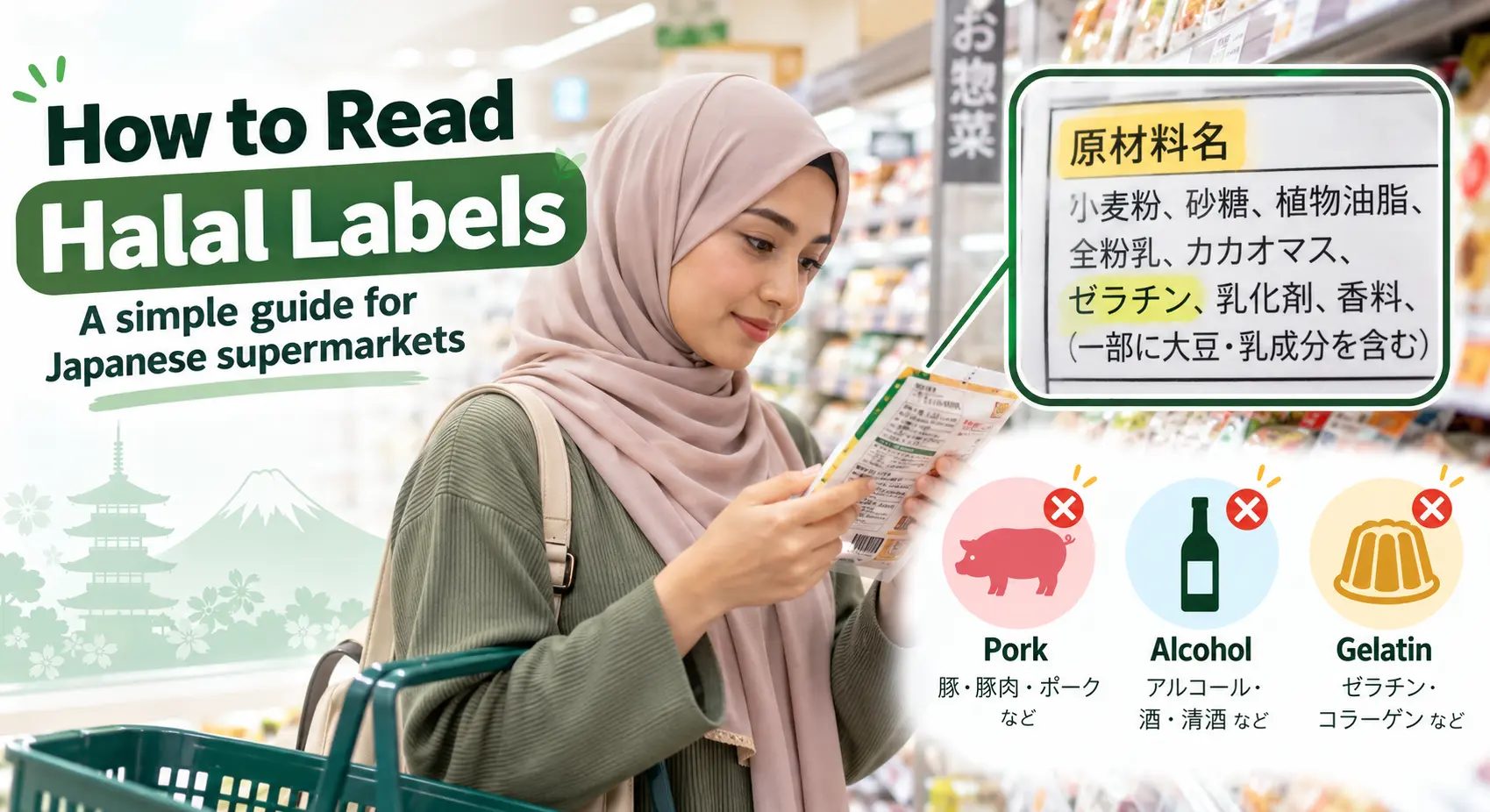
Turn the pack over. Look at the back or the side. Find a box with the heading 原材料名 (genzairyomei). This is the ingredient list.
A few things make it easier to read:
- Ingredients are listed from the largest amount to the smallest.
- Main ingredients come first.
- Additives often come after a slash (/) or on a new line. You may see the word 添加物 (tenkabutsu), which means additives.
Near it, you will also see the allergen box, アレルギー表示. It lists common allergens like milk, egg, and wheat. It is useful, but do not rely on it for halal checks. Pork is not always shown there. Alcohol never is.
Also look at the maker's name (製造者) and the origin line (原産地). They help if you want to research a brand later.
Pork words you must know
Learn these first. They matter most.
Japanese | Romaji | Meaning |
豚 / 豚肉 | buta / butaniku | Pork |
ポーク | pōku | Pork |
ラード | rādo | Lard |
ベーコン | bēkon | Bacon |
ハム | hamu | Ham |
ソーセージ | sōsēji | Sausage |
豚エキス | buta ekisu | Pork extract |
Pork hides in places you might not expect. Think ramen soup, gyoza, curry roux, croquettes, and the flavour packets in instant noodles. If you love ramen at home, see our guide to halal instant noodles in Japan before you shop.
A label that only says "meat extract" (肉エキス, niku ekisu) may include pork. When in doubt, leave it.
Hidden ingredients to watch
Pork is not the only worry. Check these too.
Gelatin (ゼラチン, zerachin). It is found in jelly, gummies, marshmallows, yogurt, and some desserts. It often comes from pork. The label rarely names the source.
Alcohol (アルコール, arukōru). You may see it as 調味料(アルコール), which means seasoning (alcohol). It is easy to miss.
Sake (酒), mirin (みりん), and liquor (洋酒, yōshu). These are common in sauces, marinades, soup bases, cakes, and sweets. Some soy sauces also add alcohol.
Animal fat (動物性油脂, dōbutsusei yushi). The animal is not named. It could be pork lard. You may also see beef fat, 牛脂 (gyūshi). That is only fine if the beef is halal.
Extracts (エキス, ekisu). Chicken, beef, and pork extracts are all common. Check which animal it is. Beef and chicken must be halal too.
Emulsifier (乳化剤, nyūkazai) and flavour (香料, kōryō). These are often plant-based, but the label does not say. If you are strict, look for a halal mark.
Red dye from insects (コチニール, kochinīru, or カルミン酸, karumin-san). Scholars differ on this one. Know your own comfort level.
One more thing. A "vegetarian" label does not always mean halal. A veggie sauce can still contain alcohol.
Halal certification marks
A halal mark is the fastest check. It tells you a certifying body looked at the product.
In Japan, you may see marks from local bodies. Imported goods may carry marks from other countries, like Malaysia or Indonesia. Each body has its own standards. Some shoppers trust some bodies more than others. Choose what fits your own beliefs.
When you see a mark, ask yourself:
- Is the logo printed clearly on the pack, not only on a shelf sign?
- Does it name the certifying body?
- Does it cover this exact product? A mark on one flavour does not always cover the whole range.
- Is the certificate current? You can ask the seller or check the body's website.
Even with a mark, a quick look at the ingredients takes five seconds. It is a good habit.
Tired of checking every label? AA Halal Foods is a halal grocery store in Japan that delivers to your door. Browse our range and shop with less guesswork.
A quick five-step check at the shelf
Use this routine every time. It becomes fast with practice.
- Look for a halal mark on the front or back.
- Find the 原材料名 box.
- Scan for pork words.
- Scan for alcohol, gelatin, and animal fat.
- Still unsure? Skip it, or ask the maker or the shop.
A translation app helps too. Open the camera mode and point it at the label. Machine translation can get things wrong, so match what it shows against the key words in this guide.
Looking for easy snack picks? Start with our list of the best halal biscuits in Japan.
Common mistakes to avoid
- Trusting the picture. A photo of chicken does not mean halal chicken.
- Reading only the front. The facts are on the back.
- Thinking "no meat" means halal. Alcohol and gelatin can still be inside.
- Assuming seafood snacks are always safe. Seasonings may contain alcohol or extracts.
- Skipping the small print. Additives sit at the end of the list.
- Buying by brand alone. Recipes change. Check again, even for products you buy often.
Final thoughts
Reading halal labels in Japan feels hard at first. It gets easy fast. Find the ingredient box. Learn the pork words. Watch for alcohol, gelatin, and animal fat. Look for a trusted halal mark.
Or skip the label hunt. AA Halal Foods brings halal groceries to your door, including fresh halal beef in Japan. Order online today and shop with peace of mind.
FAQs about halal beef in Japan
Is Japanese soy sauce halal?
It depends on the brand. Some add alcohol. Check the label for アルコール or 酒. Some brands are also halal certified.
Does "no pork" mean halal?
No. Halal also covers alcohol, the source of animal ingredients, and how the meat was slaughtered.
Can I trust the allergen box for halal?
No. It lists allergens, not halal issues. Always read the full ingredient list.
Is beef halal if it has no pork in it?
Leave it on the shelf. Or ask the maker or the seller. When unsure, skip it.